
Loan Estimate (LE)
What is a Loan Estimate?
A Loan Estimate is a three-page form that you receive after applying for a mortgage.
The Loan Estimate tells you important details about the loan you have requested. The lender must provide you a Loan Estimate within three business days of receiving your application.
The form provides you with important information, including the estimated interest rate, monthly payment, and total closing costs for the loan. The Loan Estimate also gives you information about the estimated costs of taxes and insurance, and how the interest rate and payments may change in the future. In addition, the form indicates if the loan has special features that you will want to be aware of, like penalties for paying off the loan early (a prepayment penalty) or increases to the mortgage loan balance even if payments are made on time (negative amortization). If your loan has a negative amortization feature, it appears in the description of the loan product.
The form uses clear language and design to help you better understand the terms of the mortgage loan you've applied for. All lenders are required to use the same standard Loan Estimate form. This makes it easier for you to compare mortgage loans so that you can choose the one that is right for you.
When you receive a Loan Estimate, the lender has not yet approved or denied your loan application. The Loan Estimate shows you what loan terms the lender expects to offer if you decide to move forward. If you decide to move forward, the lender will ask you for additional financial information.
Note: You will not receive a Loan Estimate or Closing Disclosure if you are shopping for:
A manufactured housing or mobile home loan not secured by real estate
A subordinate loan through certain types of homebuyer assistance programs
For these kinds of loans, you should receive Truth-in-Lending disclosures. If you are shopping for a reverse mortgage, you will also receive a Good Faith Estimate (GFE) and a HUD-1 or HUD-1A Settlement Statement.
Under federal rules, a mortgage lender must provide a standardized Loan Estimate form within three business days of receiving just six specific pieces of information from you: your name, income, Social Security number, property address, estimated property value, and desired loan amount.
Required Information for a Loan Estimate to be issued
Your name to identify the applicant.
Your income to evaluate initial financial capacity.
Your Social Security number to pull your credit report.
The property address of the home you want to buy or refinance.
An estimate of the property's value to gauge the baseline worth.
The desired loan amount you want to borrow.
Rules and Guidelines
As noted, lenders are legally obligated to issue this form once these six items are provided. According to guidelines from the Consumer Financial Protection Bureau, lenders cannot demand supporting documents—like W-2s or pay stubs—just to issue a Loan Estimate. They also cannot charge any fees aside from a basic credit report fee until you receive the form and state that you intend to move forward.
Loan Estimate Explainer
A Loan Estimate tells you important details about a mortgage loan you have requested. Use this tool to review your Loan Estimate to make sure it reflects what you discussed with the lender. If something looks different from what you expected, ask why. Request multiple Loan Estimates from different lenders so you can compare and choose the loan that's right for you.
How to use the tool to review your Loan Estimate: Below you'll see the actions you should take to review your Loan Estimate and some handy definitions to know when you do.
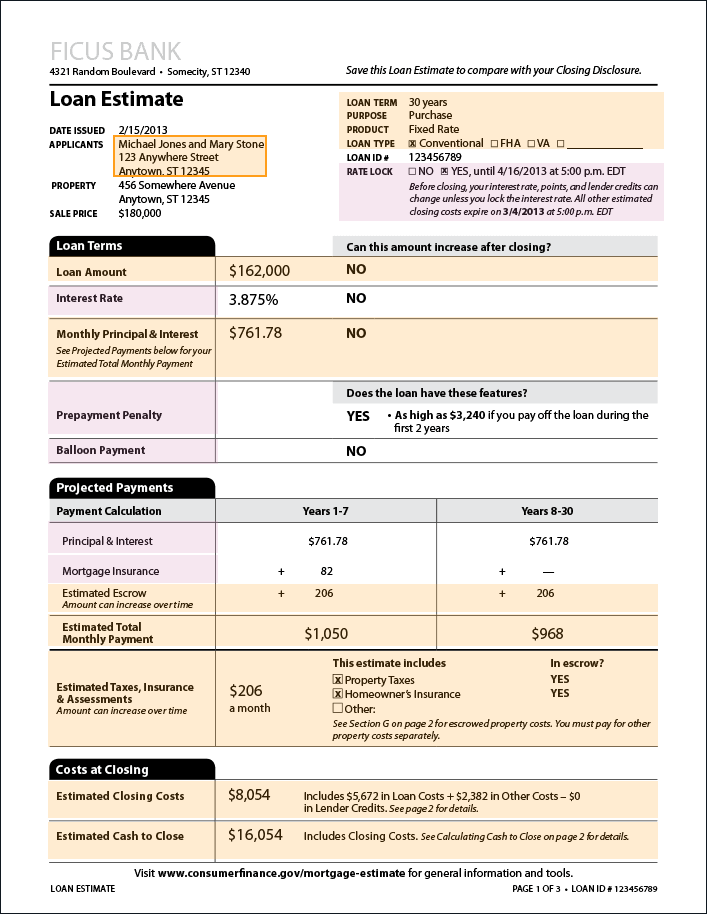
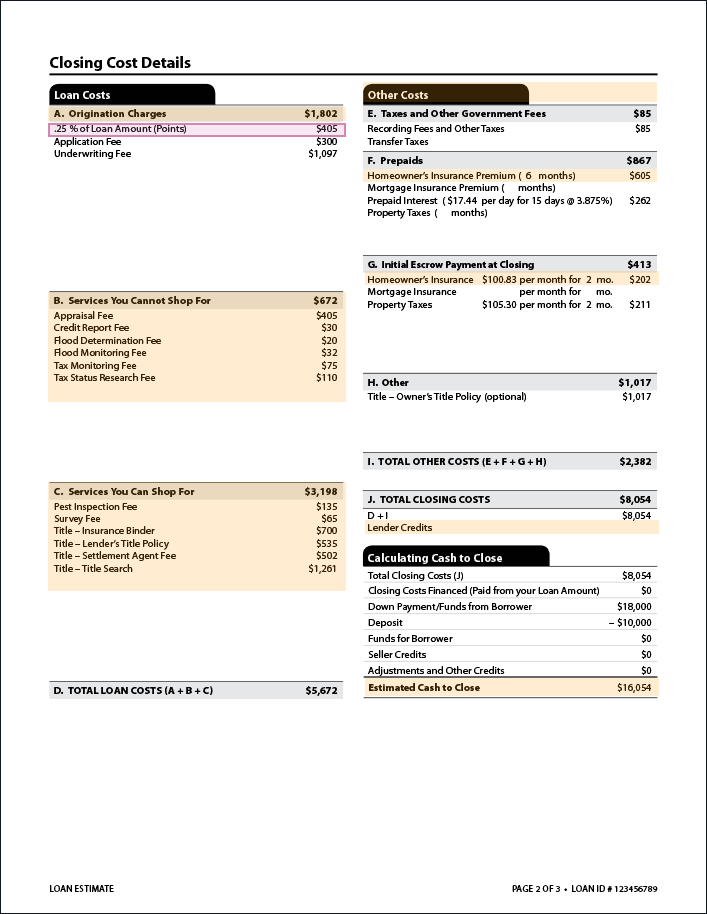
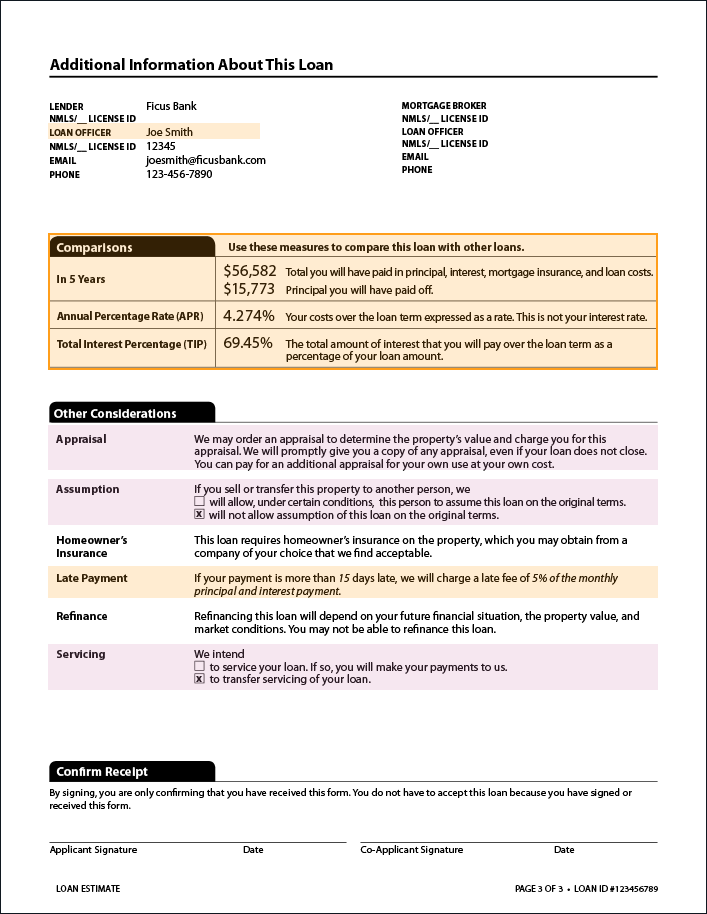
The sample Loan Estimate shows you where you'll find information on your own form. When you select any of the items on the Loan Estimate, the tool highlights the information on the image and also highlights the explanation. You can download the sample Loan Estimate if you'd like to print it or just get a better look.
Sample Loan Estimate
Page 1 of 3
Date of Last Revision: August 8, 2026
Page 2 of 3
Page 3 of 3
Actions to take
-
Ask the lender to correct any inaccurate contact information. Even minor misspellings can cause big problems later.
-
Make sure the information matches what you discussed with your lender.
-
If you are purchasing a new home, check to see that the loan amount plus your down payment equals the sale price of the home. If it doesn’t, ask the lender why.
-
Principal (the amount you will borrow) and interest (the lender's charge for lending you money) usually make up the main components of your monthly mortgage payment.
Your total monthly payment will typically be more than this amount due to taxes and insurance. See the Estimated Total Monthly Payment.
-
There might be other charges related to homeownership, such as property taxes and homeowners' insurance, that are bundled in your monthly payment. This portion of your payment will come from your escrow account.
-
This is the total payment you will make each month, including mortgage insurance and escrow, if applicable. Make sure you are comfortable spending this much on housing each month.
-
If so, you will have to pay these costs directly, often in large lump sum payments. Make sure you are able to spend this additional amount, and know how often you will make payments.
-
Closing costs, or "settlement costs," are the upfront costs you will be charged to get your loan and transfer ownership of the property. They are part of what you will have to pay at closing.
-
This is the amount you will have to pay at closing, in addition to any money you have already paid. This payment is usually made by cashier’s check or wire transfer. You will need to provide your lender with proof of the source of these funds.
Definitions to know
-
Some lenders may lock your rate as part of issuing the Loan Estimate, but some may not.
-
If the right-hand column says “YES,” your interest rate is adjustable and can change after closing. Make sure your Loan Estimate shows the type of interest rate you were expecting.
If you have an adjustable rate, your Loan Estimate form will have additional information in the Projected Payments table on page 1 and in two additional tables at the bottom of page 2. See a sample Loan Estimate for an adjustable-rate loan .
Learn more about the difference between fixed and adjustable rates
-
This feature is risky. A prepayment penalty means that the lender can charge you a fee if you pay off your mortgage early. If your loan includes a prepayment penalty, learn more and ask your lender about your other options.
-
This feature is risky. A balloon payment means that the final mortgage payment is a lump sum much larger than the regular monthly payments, often tens of thousands of dollars. If your loan includes a balloon payment, ask your lender about your other options.
-
Principal (the amount you will borrow) and interest (the lender's charge for lending you money) usually make up the main components of your monthly mortgage payment.
Your total monthly payment will typically be more than this amount due to taxes and insurance. See the Estimated Total Monthly Payment.
-
Mortgage insurance is typically required if your down payment is less than 20 percent of the price of the home. Ask the loan officer about different options and timeframes.
Actions to take
-
The best way to tell if you have a competitive loan offer is to compare it to Loan Estimates from other lenders. Origination charges are upfront fees charged by your lender, and are an important part of the cost of your loan. When comparing Loan Estimates, make sure to compare the origination charges.
Depending on the lender, origination charges may be more or less itemized. Common origination charges include application fees, origination fees, underwriting fees, processing fees, verification fees, and rate-lock fees. It’s the total that matters.
-
There are third-party services required by your lender in order to get a loan. These services are also sometimes referred to as "closing services" or “settlement services.”
The services and service providers in this section are required and chosen by the lender. Because you can’t shop separately for lower prices from other providers, compare the overall cost of the items in this section to the Loan Estimates from other lenders.
Some fees in this section may depend on the kind of loan you have chosen. For example, if you have an FHA, VA, or USDA loan, the upfront mortgage insurance premium or funding fee will appear in this section. These fees are usually set by the government program and not the lender. If you have a conventional loan with private mortgage insurance (PMI), any upfront mortgage insurance premium would typically be listed in this section. PMI premiums are set by the private mortgage insurance company, which is usually chosen by your lender.
-
The services in this section are required by the lender, but you can save money by shopping for these services separately.
Along with the Loan Estimate, the lender should provide you with a list of approved providers for each of these services. You can choose one of the providers on the list. You can also look for other providers, but check with your lender about any provider not on the list.
-
These costs are associated with the real estate transaction transferring the property to you and costs associated with owning your home.
-
The homeowner’s insurance premium is set by the homeowner’s insurance company, not by the lender. You get to choose your homeowner’s insurance company. Comparison shop to find the insurance policy you want and to learn if the amount the lender estimated is accurate for your specific situation. Usually you’ll pay the first 6 to 12 months of homeowner’s insurance premiums at or before closing. Homeowner’s insurance is also sometimes referred to as “hazard insurance.”
-
Property taxes are set by your local or state government, not by the lender. To avoid surprises later, check now to find out whether the lender has estimated these costs accurately. Contact your local tax authority or ask your real estate agent for more information about property taxes in your area.
-
If there is an amount listed on this line, it means that the lender is giving you a rebate to offset your closing costs. You may be paying a higher interest rate in exchange for this rebate. Did you discuss this choice with the lender? A similar loan may be available with a lower interest rate and without lender credits, if you prefer. Ask the lender what other options may be available to you, and how the other options would impact your interest rate and the total cost of your loan.
-
Your Estimated Cash to Close is the estimated amount of money you will have to bring to closing. This section shows how the Estimated Cash to Close was calculated. Your Estimated Cash to Close includes your down payment and closing costs, minus any deposit you have already paid to the seller, any amount the seller has agreed to pay toward your closing costs (seller credits), and other adjustments.
If the Estimated Cash to Close isn’t what you were expecting, ask the lender to explain why. You will typically need a cashier's check or wire transfer for this amount at closing. The lender you choose will also need to document the source of the funds you bring to closing. Ask the lender about what documents you will need
Definitions to know
-
Points are an upfront fee that you pay to your lender in exchange for a lower interest rate than you would have paid otherwise. If there is an amount listed on this line, it means that you are paying points to the lender to reduce your interest rate. Did you discuss this choice with the lender? A similar loan may also be available without points, if you prefer. Ask the lender what other options may be available to you, and how the other options would impact your interest rate and the total cost of your loan.
Actions to take
-
Is the loan officer that you are working with listed here? If not, ask questions.
Most loan officers are required to be licensed or registered with the Nationwide Mortgage Licensing System & Registry (NMLS). You can look up the loan officer by name or NMLS ID number in the NMLS database . In most cases, it will tell you whether the loan officer is authorized to operate in your state and whether there are any disciplinary actions on their record.
-
This section offers several useful calculations to compare the cost of this loan offer with other offers from different lenders. Because loan costs vary both across lenders and across different kinds of loans, it’s important to request Loan Estimates for the same kind of loan from different lenders.
The APR is one measure of your loan’s cost. Learn more about how your APR is different from your interest rate
Total Interest Percentage (TIP) This number helps you understand how much interest you will pay over the life of the loan and lets you make comparisons between loans
-
It’s important to make your mortgage payments on time and in full, every month, to avoid fees and improve your credit record. However, it’s good to know in advance how much the fee will be if your payment is late.
Definitions to know
-
The lender uses an appraisal to decide how much your home is worth. The appraisal is conducted by an independent, professional appraiser. You have a right to receive a copy.
-
If your loan allows assumptions, that means that if you sell the home, the buyer may be allowed to take over your loan on the same terms, instead of having to get a new loan. If your loan does not allow assumptions, the buyer will not be allowed to take over your loan. Most loans do not allow assumptions.
-
Servicing means handling the loan on a day-to-day basis once the loan is made—for example, accepting payments and answering questions from borrowers. The lender can choose to service your loan itself, or transfer that responsibility to a different company.
Learn more about the difference between a lender and a servicer
Truth-in-Lending (TIL)
What is a Truth-in-Lending disclosure for certain mortgage loans?
A Truth-in-Lending Disclosure Statement provides information about the costs of your loan.
For most mortgage loans where you are giving your home as collateral you will receive a form called the Loan Estimate instead of the initial Truth-in-Lending disclosure, and a Closing Disclosure instead of the RESPA HUD-1 Settlement Statement and the final Truth-in-Lending disclosures. The information provided is comparable to that provided by the Loan Estimates and Closing Disclosures.
You should receive Truth-in-Lending disclosures if you are shopping for a:
Manufactured housing or mobile home loan not secured by real estate
Subordinate loan through certain types of homebuyer assistance programs
If you are shopping for a reverse mortgage, you will also receive a Good Faith Estimate (GFE) and a HUD-1 Settlement Statement.
Good Faith Estimate (GFE)
A Good Faith Estimate, also called a GFE, is a document that a lender must provide when you apply for a reverse mortgage. The GFE lists basic information about the terms of the loan offer.
The GFE includes the estimated costs for the reverse mortgage. The Good Faith Estimate provides basic information about the loan, including estimated costs, which helps you:
Compare offers
Understand the terms and the real cost of the loan
Make an informed decision about choosing a reverse mortgage
For most other kinds of mortgages, you will get a Loan Estimate instead of a GFE.
Unless an exception applies, the lender must provide you with a GFE within three business days of receiving your application or other required information. You can be charged a credit report fee before receiving a GFE. But you can't be charged any other fees until you get the GFE and indicate that you want to proceed with the mortgage loan. In addition to a GFE, you should also receive a HUD-1 Settlement Statement at closing.
Tip: You don't have to accept the reverse mortgage loan offer just because you receive a GFE. You can shop around and get multiple GFEs before choosing a loan or a lender.
HUD-1 or HUD-1A Settlement Statement
What is a HUD-1 Settlement Statement?
The HUD-1 Settlement Statement is a document that lists all charges and credits to the buyer and to the seller in a real estate settlement, or all the charges in a mortgage refinance.
If you applied for a mortgage on or before October 3, 2015, or if you are applying for a reverse mortgage, you receive a HUD-1. In transactions that do not include a seller, such as a refinance loan, the settlement agent may use the shortened HUD-1A form.
If you applied for a mortgage after October 3, 2015, for most kinds of mortgage loans you receive a form called the Closing Disclosure instead of a HUD-1.
Note: You will not receive a Loan Estimate or Closing Disclosure if you are shopping for:
A manufactured housing or mobile home loan not secured by real estate
A subordinate loan through certain types of homebuyer assistance programs
For these kinds of loans, you should receive Truth-in-Lending disclosures. If you are shopping for a reverse mortgage, you will also receive a Good Faith Estimate (GFE) and a HUD-1 or HUD-1A Settlement Statement.