
What is a mortgage pre-approval?
Date of Last Revision: August 8, 2026
a mortgage pre-approval is a conditional statement from a lender showing how much money they may lend you. It requires verified financial data and a credit check, but it is not a guaranteed loan
How Pre-Approval Works
Financial review: Lenders look at your pay stubs, tax forms, and bank statements.
Credit check: Lenders run a hard inquiry on your credit report.
Loan limit: The resulting letter sets a maximum borrowing amount.
Expiration: Letters typically expire in 30 to 90 days.
Pre-Approval vs. Prequalification
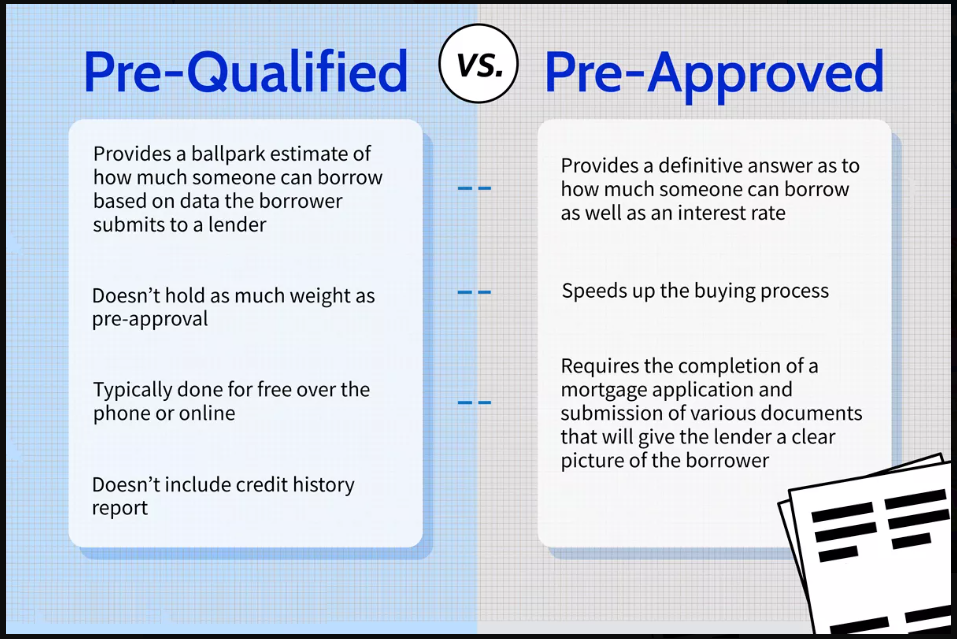
Prequalification: Based on unverified, self-reported numbers with little to no credit review.
Pre-Approval: Based on verified documentation and a formal credit pull, carrying much more weight with home sellers.
If you are planning to buy a home, would you like tips on improving your credit score before applying, or guidance on how to shop multiple lenders without hurting your credit?
What’s the difference between a prequalification letter and a preapproval letter?
Prequalification and preapproval letters both specify how much the lender is willing to lend to you, up to a certain amount and based on certain assumptions. These letters provide useful information about your likelihood of getting a loan but are not guaranteed loan offers.
Lenders use the terms “prequalification” and “preapproval” differently. Some lenders may use the word “prequalification,” while other lenders may call the letter a “preapproval.” Some lenders offer a prequalification letter based on unverified information that you report and will only issue a preapproval letter based on verified information. In connection with a prequalification or preapproval request, some lenders may issue a written commitment letter valid for a certain period of time to extend a loan up to a specified amount subject to limited conditions.
Don’t worry about which word lenders use. Lenders’ processes vary widely, and the words they use don’t tell you much about a particular lender’s process even if it may result in legal differences. Both terms refer to a letter from a lender that says the lender is generally willing to lend to you, up to a certain amount and based on certain assumptions. This letter helps you to make an offer on a home, because it gives the seller confidence that you will be able to get financing to buy the home. It is not a guaranteed loan offer, but it should provide enough information for sellers in your area to take it seriously. The best way to make sure that the letter you have will serve its purpose is to ask a local real estate agent or a housing counselor.
Lenders maycheck your credit when issuing a prequalification or preapproval letter. Many people wait to get a preapproval letter until they are ready to begin shopping seriously for a home. However, getting preapproved earlier in the process can be a good way to spot potential issues with your credit in time to correct them. In addition, even if you have not submitted a formal loan application, a lender that evaluates your creditworthiness and tells you that you do not qualify for a prequalification or preapproval letter must provide you with an adverse action notice.
Get a preapproval letter
A preapproval letter is a statement from a lender that they are tentatively willing to lend money to you, up to a certain loan amount.
A preapproval letter is based on assumptions and it is not a guaranteed loan offer. But, it lets the seller know that you are likely to be able to get financing. Sellers frequently require a preapproval letter before accepting your offer on a house.
What to do now
Decide when to get a preapproval letter
Lenders typically check your creditbefore issuing a preapproval letter, and the letter can have an expiration date on it (typically 30 to 60 days). For these reasons, many people wait to get a preapproval letter until they are ready to begin shopping seriously for a home. However, getting preapproved early in the process can be a good way to spot potential issues in time to correct them.
Find out what the lender’s preapproval process is
Every lender is different. Find out what you need to do and what documentation is requested.
Request a preapproval
Follow up with the lender and provide the necessary information.
Ask questions
Ask the lender what assumptions they made to issue the preapproval. Is there anything about your situation that could lead to your loan being denied later, or that could increase your interest rate or loan costs?
What to know
Different lenders use the terms “prequalification” and “preapproval” differently
Some lenders offer only a “prequalification.” Other lenders offer only a “preapproval.” For simplicity, we use the word “preapproval.” Find more details about prequalification and preapproval by asking questions.
Different lenders may request different levels of information and documentation
Some lenders base preapproval letters solely on the information you provide. Other lenders dig into the details with you now to make certain you have all the documentation you need and prevent delays and surprises later. Ask questions. All lenders require documentation at some point if you decide to apply for a loan. It’s better to know now that you need an additional document (which could take some time to get) than when you’re about to close.
Getting a preapproval letter isn't the same thing as applying for a loan
A preapproval letter just says that a lender is willing to lend to you – pending further confirmation of details. A preapproval helps you shop for a home, because it lets the seller know you are a serious buyer.
There's no need to choose a lender just yet
Getting preapproved is important because it helps you shop for a home. But your preapproval letters don’t give you enough information to make a decision about which lender offers the best deal. Getting a preapproval doesn’t commit you to using that lender for your loan. Wait to decide on a lender until you've made an offer on a house and received official Loan Estimates from each of your potential lenders.
How to avoid pitfalls
You’re the only one who can decide how much you can afford to spend on a home
Lenders preapprove you by looking at your income, assets, debts, and credit record. But your financial life is much more complicated than that. Only you can decide how much you’re comfortable paying upfront and each month — which means only you can decide how much to spend on a home.
If you were preapproved for more than the home price budget you set for yourself, you can use the preapproval letter to shop for homes without changing your target home price. If you’re happy with the amount you planned to spend, stick with your original budget.
If you were preapproved for less than you were planning to spend on a home, talk with the lender. Ask if there was a particular factor (for example, your income) that limited the preapproval amount. You might need to adjust your home price expectations.
Be upfront with your real estate agent. If you don’t want to see homes above a certain price, say so. Limiting your search is a good way to avoid falling in love with a home that costs more than you want to spend.
If you get declined for your preapproval, you still have options
Find out why you were declined, so you can figure out what to do to improve your chances of getting a loan in the future.
Ask the lender to explain why you were declined. Was your credit score too low? Was there specific negative information on your credit report?
Ask to see a copy of the credit score the lender used. If the lender used your credit score to deny your preapproval request, the lender must send you a notice with the credit score they used to make the decision and instructions on how to get a free copy of your credit report.
If there are errors on your credit report, get them corrected.
If you need help improving your credit, contact a HUD-approved housing counseling agency. You can find a counselor online or by calling 1-800-569-4287.