
Closing Disclosure (CD)
Use this tool to double-check that all the details about your loan are correct on your Closing Disclosure. Lenders are required to provide your Closing Disclosure three business days before your scheduled closing. Use these days wisely—now is the time to resolve problems. If something looks different from what you expected, ask why.
How to use this tool to review your Closing Disclosure: Below you'll see the actions you should take to review your Closing Disclosure and some handy definitions to know when you do.
The sample Closing Disclosure shows you where you'll find information on your own form. When you select any of the Closing Disclosure, the tool highlights this information on the image and also highlights the explanation. You can download the sample Closing Disclosure if you'd like to print it or just get a better look.
Sample Closing Disclosure
Page 1 of 5
Page 2 of 5
Page 3 of 5
Page 4 of 5
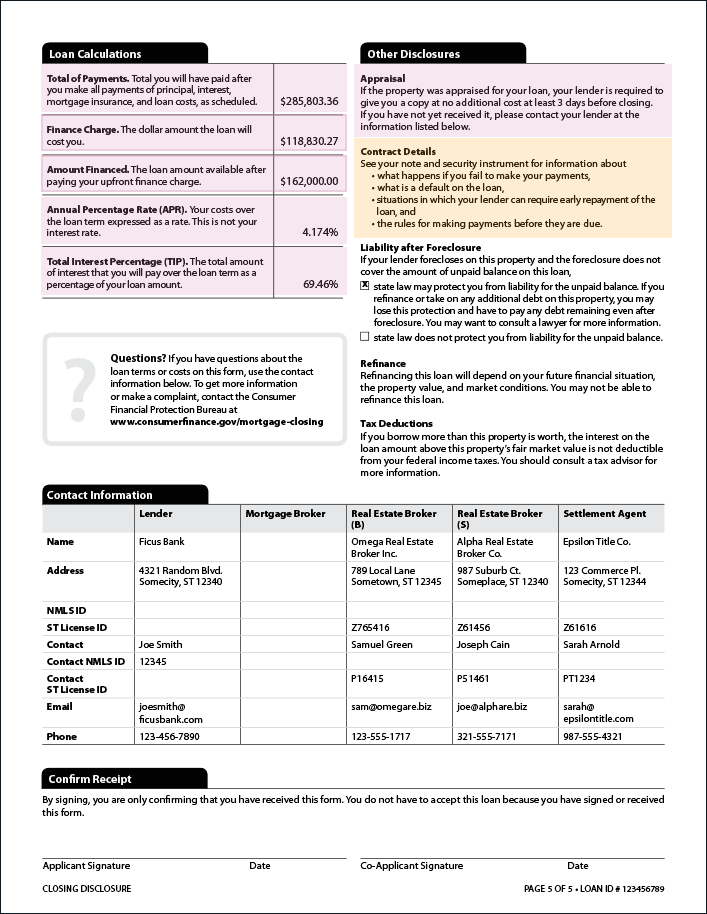
Page 5 of 5
Details to check
-
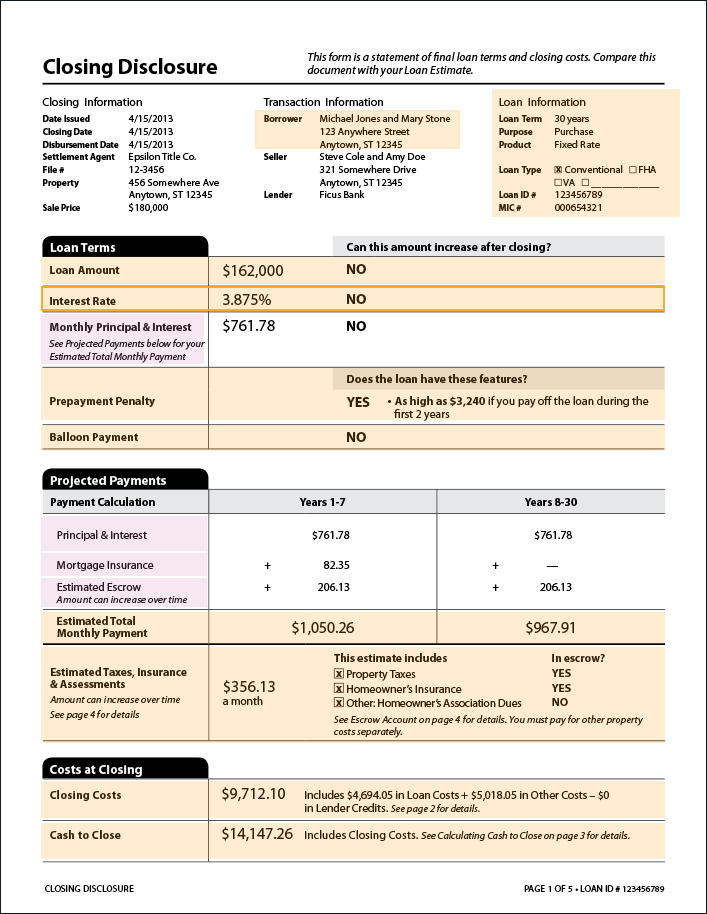
Ask the lender to correct any inaccurate contact information. Even minor misspellings can cause big problems later.
-
It's very important these items match what you were expecting. If they don't, call your lender immediately and ask why they have changed.
-
If it has increased, ask your lender why. A possible reason could be that closing costs have been rolled into your loan. This reduces your upfront costs at closing, but adds to your overall costs because of the added interest you will pay.
-
If your interest rate isn't what you were expecting, ask your lender why. If you locked your rate, your lender is only allowed to change it under limited circumstances.
-
This feature is risky. A prepayment penalty means that the lender can charge you a fee if you pay off your mortgage early. If your loan includes a prepayment penalty, learn more and ask your lender about your other options.
-
This feature is risky. A balloon payment means that the final mortgage payment is a lump sum much larger than the regular monthly payments, often tens of thousands of dollars. If your loan includes a balloon payment, ask your lender about your other options.
-
Make sure you can comfortably afford to pay the Estimated Total Monthly Payment every month. If this number doesn't reflect what you were expecting, ask your lender why it has changed.
-
If so, have you budgeted to pay for these costs separately?
-
Closing costs, or "settlement costs," are the upfront costs you will be charged to get your loan and transfer ownership of the property.
If there are significant changes in your closing costs, ask your lender to explain why.
-
This is the total amount you will have to pay at closing, in addition to any money you have already paid.
If this amount does not match your Loan Estimate, ask your lender to explain why.
Get Definitions
Date of Last Revision: August 8, 2026
-
Principal (the amount you will borrow) and interest (the lender's charge for lending you money) usually make up the main components of your monthly mortgage payment.
Your total monthly payment will typically be more than this amount due to taxes and insurance. See the Estimated Total Monthly Payment.
-
Principal is the amount you will borrow.
Interest is the lender's charge for lending you money. -
Mortgage insurance is typically required if your down payment is less than 20 percent of the price of the home.
-
Additional charges related to homeownership, such as property taxes and homeowners' insurance, that are bundled in your monthly payment.
Details to check
-
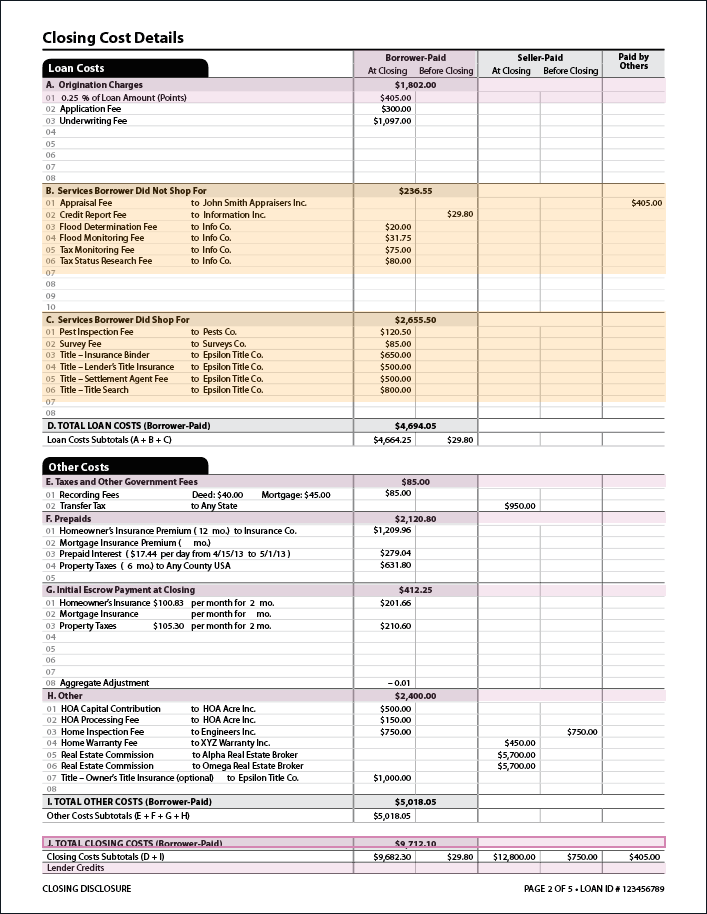
These are third-party services required by your lender in order to get a loan. Compare with Section B, “Services You Cannot Shop For” and Section C, “Services You Can Shop For” on page 2 of your Loan Estimate form. Check to see that, overall, there are no new services listed that were not on your Loan Estimate form. The costs should be similar, but may be somewhat different from what was on your Loan Estimate form.
Learn more about when these costs are allowed to change between Loan Estimate and closing
-
These are services that you shopped for separately. If there are any services in this section that you do not recognize, or companies that you did not choose, ask your lender to explain what these charges are for and how the companies were chosen.
Get definitions
-
This column lists the costs that are charged to you.
-
Upfront charges from your lender for making the loan.
-
An upfront fee that you pay to your lender in exchange for a lower interest rate than you would pay otherwise.
-
Costs associated with transferring the property to you and registering your mortgage with the county records office.
-
This category includes interest on your loan between the time you close and the end of that month. It’s also common to pay your first year’s homeowner’s insurance premium in advance at closing.
-
This payment will establish an initial balance in your escrow account.
-
Costs for other services you have chosen. Review these amounts to make sure they match what you are expecting.
-
Total upfront costs associated with your loan and real estate transaction, excluding your down payment. This is different from the actual amount of money you have to bring to closing, which is called “Cash to Close” on page 3.
-
A rebate from your lender that offsets some of your closing costs. Lender credits are typically provided in exchange for a higher interest rate than you would have paid otherwise. Learn about lender credits.
Learn more Lender Creidit
Details to check
-
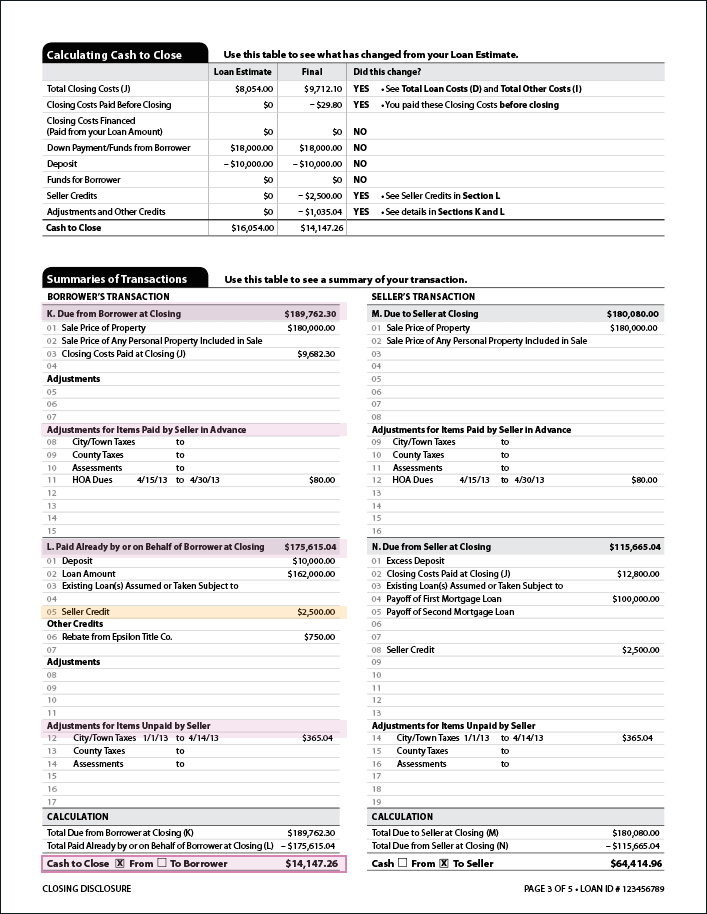
This is the amount the seller has agreed to contribute to your closing costs. If the seller has agreed to pay for specific costs rather than contribute a general amount, those amounts may be listed as “Seller Paid” line items on page 2 instead.
Get definitions
-
Total amount charged to you at closing. It includes your house price and closing costs. It doesn't include any credits or rebates that lower your closing costs. (Those are below in Section L).
-
Costs that have been prepaid by the seller that you are now reimbursing the seller for.
-
This section details how you will pay for the items in Section K. It includes the amount you are borrowing, the amount of your deposit, and any rebates or credits paid by the seller or third-party service providers. It does not include the amount you have to bring to closing—that’s below in “Cash to Close.”
-
Prior taxes and other fees owed by the seller that you will pay in the future. The seller is reimbursing you now to cover these expenses.
-
Actual amount you will have to pay at closing. You will typically need a cashier's check or wire transfer for this amount. Ask your closing agent about how to make this payment. Depending on your location, this person may be known as a settlement agent, escrow agent, or closing attorney.
Details to check
-
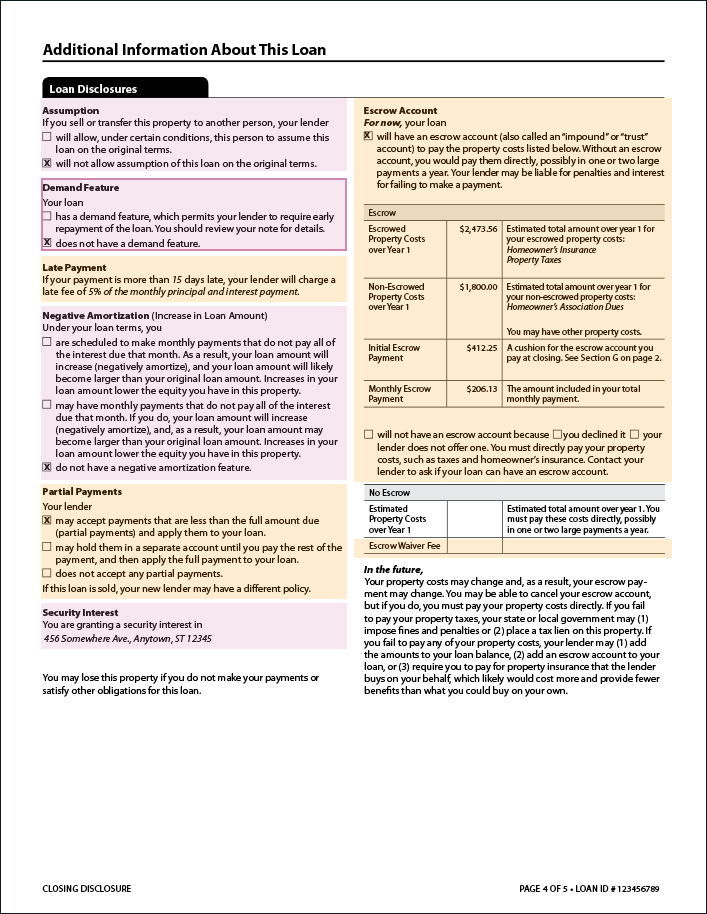
It’s important to make your mortgage payments on time and in full, every month, to avoid fees and improve your credit record. However, it’s good to know in advance how much the fee will be if your payment is late.
-
If you are unable to make the full mortgage payment in a given month, your lender may not accept a partial payment. Even if the lender accepts partial payments, the lender may hold them in a separate account instead of applying them to your loan. The lender may also charge you a late fee every month until you make up the difference. The lender may also report you to the credit reporting agencies as not making your required payment. Ask questions so you understand exactly what happens if you can’t make a payment in full.
-
An escrow account lets you pay your homeowner’s insurance and property taxes monthly as part of your mortgage payment, instead of in a large lump sum.
This section tells you: whether you have an escrow account, which homeownership expenses are included in the escrow account, and the estimated costs. Ask questions so you understand exactly what is included in the escrow account and what isn’t. For example, homeowner’s association fees are often not included in the escrow account.
If your Closing Disclosure shows that you don’t have an escrow account, but you would prefer to pay your property taxes and homeowner’s insurance monthly instead of in one large lump sum, talk to the lender.
-
Some lenders may charge a fee if you choose not to have an escrow account. Did you discuss this choice with your lender? If your Closing Disclosure shows an escrow waiver fee and you would prefer to pay your property taxes and homeowner’s insurance monthly into an escrow account instead of paying this fee, talk to the lender.
Get definitions
-
If your loan allows assumptions, that means that if you sell the home, the buyer may be allowed to take over your loan on the same terms, instead of having to get a new loan. If your loan does not allow assumptions, the buyer will not be allowed to take over your loan. Most loans do not allow assumptions.
-
A demand feature allows the lender to demand immediate payment of the entire loan at any time.
Learn more about demand features and what you need to know if your loan has one
-
Negative amortization means your loan balance can increase even if you make your payments on time and in full. Most loans do not have negative amortization.
-
The security interest allows the lender to foreclose on your home if you don’t pay back the money you borrowed.
Learn more about a security interest and why it is important
Details to check
-
It's important to read your note and security instrument (also known as the “mortgage” or “deed of trust”) carefully.
Get definitions
-
The Total of Payments tells you the total amount of money you will pay over the life of your loan, if you make all payments as scheduled.
-
The Finance Charge tells you the total amount of interest and loan fees you will pay over the life of your loan, if you make all payments as scheduled.
-
The amount financed is the net amount of money you are borrowing from the lender, minus most of the upfront fees the lender is charging you.
-
The APR is one measure of your loan’s cost.
Learn more about how your APR is different from your interest rate
-
This number helps you understand how much interest you will pay over the life of the loan and lets you make comparisons between loans.
-
The lender uses an appraisal to decide how much your home is worth. The appraisal is conducted by an independent, professional appraiser. You have a right to receive a copy.
The 3-7-3 rule is a federal mortgage regulation under the Mortgage Disclosure Improvement Act (MDIA). It sets mandatory waiting periods to protect homebuyers from being rushed and to prevent last-minute cost surprises before closing on a home loan.
The Three Timing Requirements
3 Days (Initial Disclosures): Your lender must give you a Loan Estimate showing your estimated interest rate, monthly payment, and closing costs within three business days of receiving your completed loan application.
Parish Lending +1
7 Days (Waiting Period): Your loan cannot close until at least seven business days after the initial Loan Estimate is delivered, giving you time to review and compare terms.
Parish Lending +1
3 Days (Revised Disclosures):
If your final Annual Percentage Rate (APR) changes beyond a specific threshold (like 0.125% for fixed loans), the lender must give you a new Closing Disclosure and wait another three business days before you can close.
No matter how fast you want to close your loan, there are waiting periods that are federally mandated!
The right of rescission is a consumer protection rule under the federal Truth in Lending Act (TILA) that allows borrowers to cancel certain types of loans within three business days without financial penalty.
When It Applies
The right of rescission applies strictly to specific borrowing transactions where a security interest is placed on a consumer's primary residence:
Refinancing a mortgage with a new lender
Home equity loans (HELOARs)
Home equity lines of credit (HELOCs)
Adding a security interest to an existing primary residence obligation
When It Does Not Apply
The right of rescission does not apply to:
Buying a brand-new home or initial construction loans
Refinancing with the exact same lender if no new extra money is borrowed
Second homes, vacation properties, or investment/rental properties
Auto loans or standard commercial/business loans
How the Timeline Works
The 3-Day Clock: The cancellation window lasts for three business days (which includes Saturdays, but excludes Sundays and federal holidays).
Start Date: The timeline begins the day after you sign the contract, receive the TILA disclosure, and get two copies of the notice of the right to cancel.
Extended Period (Up to 3 Years): If your lender fails to give you the required TILA disclosures or notice forms, your right to cancel can be legally extended for up to three years.
Method of Cancellation: To back out, you must notify the lender in writing (by mail, telegram, or delivery) before the time expires.