Cash Out
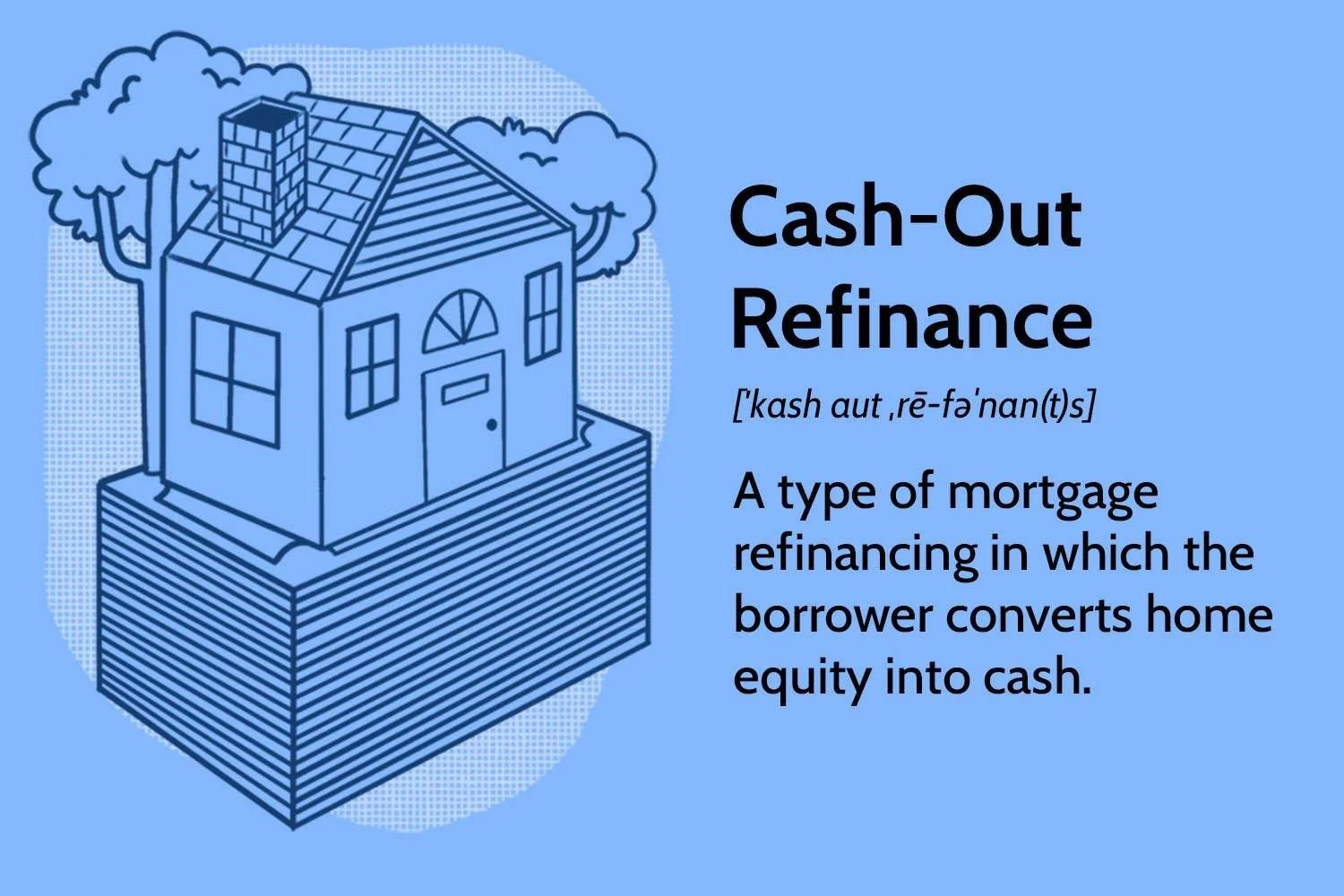
A cash-out mortgage loan (commonly called a cash-out refinance) replaces your current home mortgage with a new, larger loan so you can turn your home equity into cash.
📊 How It Works
Bigger loan: Your new mortgage is larger than what you currently owe.
Pay off old balance: The lender uses part of the new loan to pay off your original mortgage.
Pocket the cash: You receive the remaining difference as a lump sum of cash at closing.
Single payment: You replace your old monthly payment with one new monthly payment under new terms.
✅ Common Uses
Home improvements: Remodeling or repairing your property (the interest may be tax-deductible).
Debt consolidation: Paying off high-interest debts like credit cards or personal loans.
Major expenses: Paying for college tuition or making a down payment on another property.
⚠️ Key Requirements
Home equity: You usually must leave at least 20% equity in the home (maximum loan-to-value or LTV is typically 80%).
Credit score: Most conventional lenders require a minimum score of 620.
Closing costs: Expect to pay between 2% and 6% of the total loan amount in fees.
A DSCR cash-out refinance uses a property's rental income to qualify for equity withdrawal, while a conventional cash-out refinance requires personal income verification and W-2s.
📊 Comparison: DSCR vs. Conventional Cash-Out
Feature
Qualifying Metric
Income Docs Needed
Max LTV (Loan-to-Value)
Minimum Credit (FICO)
Seasoning Requirement
Entity Ownership
Portfolio Limits
💵 DSCR Cash-Out Refinance
Property rent vs. PITIA (Debt Service)
None (No W-2s, tax returns, or paystubs)
Typically up to 75% (sometimes 80% on strong files)
640+ (680–700+ recommended for best terms)
0 to 6 months (some allow instant refi post-rehab)
Allows LLC or corporate ownership
Scalable with no cap on number of financed properties
🏠 Conventional Cash-Out Refinance
Personal income & Debt-to-Income (DTI)
Full doc (Tax returns, W-2s, employment check)
Up to 75%–80% for investment properties
Usually 620–720+ depending on lender
Usually 6 to 12 months minimum
Typically in individual/personal name
Strict conventional caps (often up to 10 properties)
✅ When to Choose a DSCR Cash-Out
You are self-employed or write off too much on taxes to qualify via personal DTI.
You hold properties inside an LLC.
You completed a renovation (BRRRR strategy) and need to pull out capital quickly without a 6–12 month wait.
⚠️ When to Choose a Conventional Cash-Out
Your personal income easily supports the debt and you want a lower interest rate.
You want lower closing costs (DSCR loans carry higher rates and lender fees).
To help narrow down which option fits your portfolio, tell me:
Do you own the property in your personal name or an LLC?
Is your personal Debt-to-Income (DTI) tight, or do you have strong W-2/tax documentation?
Cashout Refinance
A cash-out refinance replaces your current property mortgage with a larger loan, allowing you to convert home equity into tax-free cash.
📊 Key Refinance Limits
Primary Residences: Typically up to 80% LTV (Loan-to-Value).
1-Unit Investment Properties: Capped at 75% LTV max.
2- to 4-Unit Investments: Capped at 70% LTV max.
Reserves Required: 6 to 12 months of mortgage payments.
💡 Common Uses & Strategies
Property Upgrades: Funding major renovations to boost rental value.
Portfolio Growth: Using extracted equity as a down payment on a new asset.
Debt Consolidation: Paying off higher-interest consumer debts.
⚠️ Risks & Considerations
Higher Rates: Investment property cash-out rates run 0.5% to 1.0% above primary residence rates.
Overleveraging: Larger monthly debt service can squeeze cash flow in tighter rental markets.
Foreclosure Risk: Defaulting on the larger new loan puts the underlying property at risk.
Commercial Cash-Out
You can cash out equity from a commercial property by executing a commercial cash-out refinance to replace your existing mortgage with a larger loan and receive the difference in cash.
📊 How Commercial Cash-Out Refinancing Works
Loan-to-Value (LTV) Cap: Typically limited to 65% to 75% of the property's appraised value.
Debt Service Coverage Ratio (DSCR): Lenders require a minimum DSCR (usually 1.25x), meaning net operating income must exceed debt payments by 25%.
Interest Rates & Terms: Rates generally range from 6.5% to 7.0% with a 25-year amortization schedule.
Closing Timeline: The process takes 75 to 105 days from application to funding.
💡 Common Use Cases
Capital Improvements: Funding renovations or tenant upgrades to boost Net Operating Income (NOI).
Portfolio Growth: Using extracted equity as a down payment on a new acquisition.
Partner Buyout: Purchasing the stake of a co-owner.
Working Capital: Consolidating high-interest debt or funding operations.
⚠️ Hidden Costs & Tax Implications
Prepayment Penalties: Existing loans may carry penalties for early payoff.
Refinancing Fees: Appraisal, legal, and origination fees typically run 1% to 3% of the loan amount.
Tax Deductibility: Interest is generally tax-deductible only if the cash-out proceeds are used directly for business or investment purposes.
📍 Local Advisory Options
If you want to evaluate your property's value or explore regional lenders near your location, consider reaching out to local professionals:
SoCal Property Advisory (Los Alamitos, CA): Offers valuation and lease analysis services.
Patrick Sharples Commercial Real Estate (Orange County, CA): Specializes in Southern California commercial sales and refinancing guidance.